
In-person payments for hairdressers and barbershops in Switzerland: How to set up card payments, TWINT and tips
Published:
Last updated (content):
Last updated (prices):
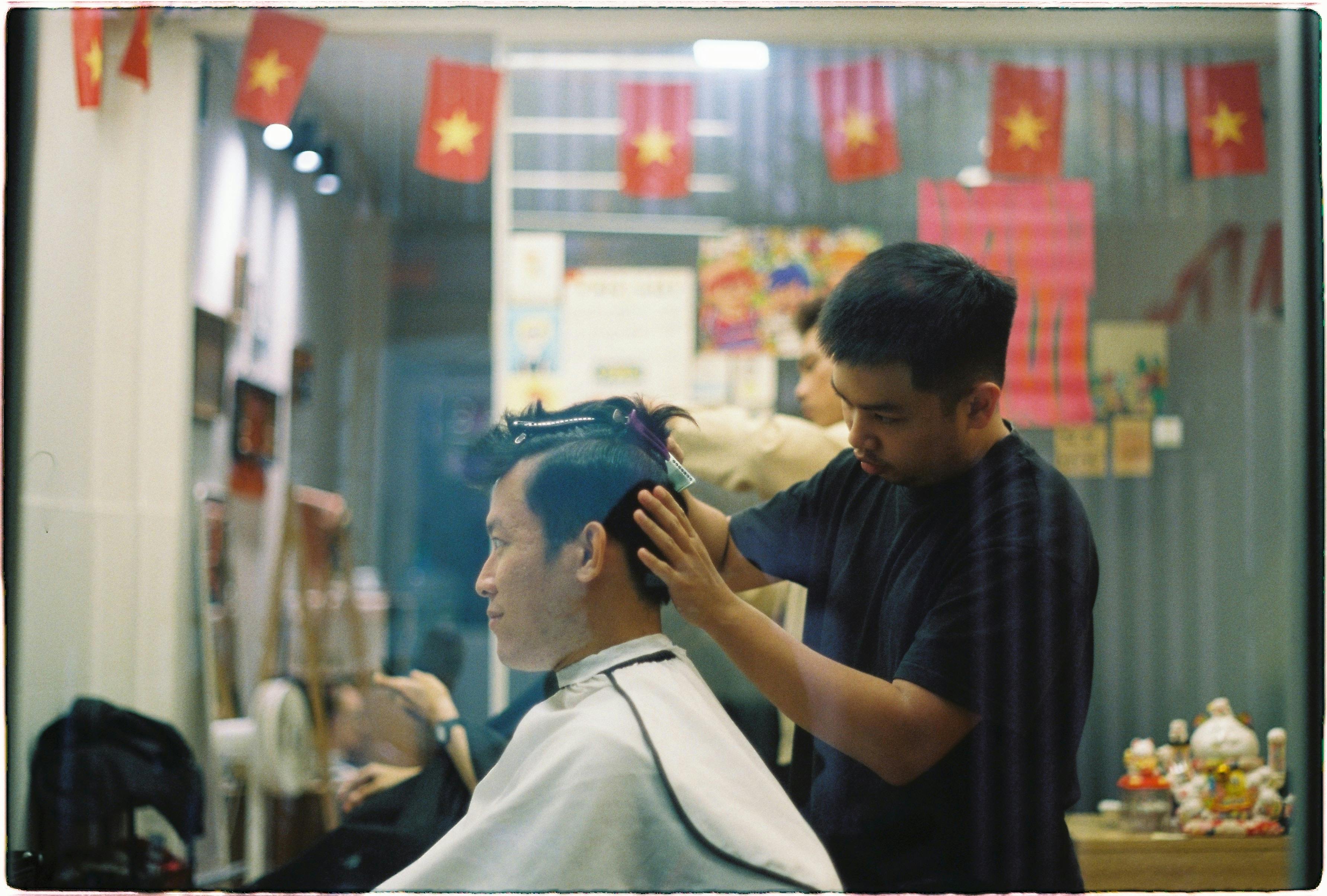
Swiss hair salons and barbershops benefit from cashless payment solutions: TWINT is used by more than 6 million people in Switzerland, and around 81% of brick-and-mortar businesses already accept the payment app. For salons, this means: those who do not offer a card terminal or TWINT lose potential walk-in customers and make the topic of tipping unnecessarily difficult. The right payment solution depends on the turnover volume, the desired TWINT integration, and the question of whether booking appointments and payment should be linked.
This guide explains step by step which payment solutions are suitable for hair salons and barbershops in Switzerland, how much they cost, and how you can set up tipping, appointment booking, and accounting properly.
1. Why Swiss customers in hair salons want to pay without cash
Payment habits in Switzerland have changed significantly in recent years. According to the Swiss Payment Monitor by the ZHAW, the debit card is the most frequently used payment method in brick-and-mortar retail, followed by cash and TWINT. For hairdressers and barbershops, this shift has three concrete implications.
Firstly, customers simply expect to be able to pay cashlessly. A salon that only accepts cash no longer seems contemporary – particularly to younger customers who view debit cards, TWINT, or Apple Pay as the standard. Secondly, TWINT has an exceptionally high penetration rate in Switzerland. In 2025, 901 million transactions were processed via TWINT, 65% of which were in presence business. Thirdly, cashless payment solves an everyday problem in the salon – tipping. When customers do not have cash on them, the tip is often omitted. A tipping function on the terminal or via the payment page makes it easy to leave a tip anyway.
Additionally, salons that wish to introduce prepayments or no-show fees for online bookings absolutely require an electronic payment solution. Without card payment or TWINT, such models cannot be implemented.
2. Terminal, Tap to Pay, or QR code: Which solution fits the salon?
For hair salons and barbershops, four basic approaches are worth considering: a physical card terminal, Tap to Pay on a smartphone (iPhone or Android), a pure TWINT QR code, or a PSP-based QR code that, in addition to TWINT, also covers credit cards and other payment methods. Each variant has advantages and disadvantages that depend on the turnover volume, technical equipment, and the desired payment methods.
Physical card terminal
A classic card terminal – from vendors such as Worldline (formerly SIX Payment Services), SumUp, or Payrexx – accepts debit cards, credit cards, and contactless payments (Apple Pay, Google Pay). Worldline and Payrexx terminals additionally support TWINT and PostFinance Card. SumUp terminals do not accept TWINT. Payrexx offers POS terminals (Nexgo N5, N6 Mini, N86) with an integrated SIM card starting from EUR 9 per month (introductory price) – the devices operate independently of the smartphone and do not require Wi-Fi in the salon. For salons with regular card turnover of EUR 3,000 or more per month, a Worldline or Payrexx terminal is worthwhile due to the lower transaction fees compared to SumUp.
Tap to Pay on iPhone or Android
Since March 2025, Tap to Pay on iPhone has also been available in Switzerland. The smartphone becomes a card terminal – without additional hardware. Providers like SumUp, Worldline, Stripe, and myPOS support the iPhone variant for debit and credit cards as well as Apple Pay and Google Pay. On Android, several providers offer SoftPOS solutions, including Payrexx Tap to Pay: the app transforms any NFC-enabled Android smartphone into a card terminal and, along with cards, also accepts TWINT, Apple Pay, and Samsung Pay – an advantage over the iPhone variant, which does not support TWINT. The transaction fees for Payrexx Tap to Pay are 1.65% + EUR 0.15 per transaction, with no fixed monthly costs for the first device. For sole traders and mobile hairdressers, Tap to Pay is an uncomplicated entry-level solution. Limitation: a stable internet connection (Wi-Fi or cellular network) is absolutely required.
TWINT QR code (static or dynamic)
A static TWINT QR code at reception is the simplest option: the customer scans the code with the TWINT app and enters the amount themselves. Transaction fee: 1.3%. This solution is suitable as a supplement to a terminal or as a standalone option for very small businesses. The disadvantage: only customers with the TWINT app can pay – tourists or people without TWINT are left out.
PSP-based QR code (e.g. Payrexx QR Pay)
A further development of the pure TWINT QR code are QR codes generated via a Payment Service Provider. The principle: the QR code can be scanned with both the TWINT app and the standard smartphone camera. In the second case, a payment page opens on which the customer can choose between TWINT, credit card, PostFinance, Apple Pay, and other payment methods. This is particularly practical for salons with international clientele or walk-in customers without TWINT. The QR code can be configured with an open, fixed, or minimum amount and placed as a poster or sticker at reception. The salon does not need its own Wi-Fi for this – the internet connection runs via the customer's smartphone.
Comparison of payment solutions
Criterion | Card terminal | Tap to Pay | TWINT QR | PSP QR-code |
Debit/credit cards | Yes | Yes | No | Yes |
TWINT | Yes (Worldline, Payrexx), no (SumUp) | Yes (Android/Payrexx), no (iPhone) | Yes | Yes |
PostFinance Card | Yes (Worldline, Payrexx) | Yes (Android/Payrexx) | No | Yes |
Additional hardware | Terminal (purchase/rental) | None (smartphone) | None (QR sticker) | None (QR sticker) |
Tipping function | Yes (depending on provider) | Yes (Payrexx), app-dep. | No (manual) | No (manual) |
Also for non-TWINT users | Yes | Yes | No | Yes |
Suitable for | Salons from EUR 3,000/mo. | Mobile hairdressers, micro-businesses | Supplement, entry level | Salons with mixed clientele |
Many salons combine two solutions: a card terminal or Tap to Pay for the main turnover, and a QR code as an additional option. Salons that wish to cover all payment methods via a single QR code use a PSP-based QR code instead of the pure TWINT QR.
3. Tipping on the card terminal: How the tipping function works in Switzerland
Tipping is common in Swiss hair salons, but not a given. Since more and more customers are paying cashlessly, the question arises: how does tipping work on a card terminal?
Preset tip amounts
The most common solution is preset tipping options on the terminal display. Typical tiers: 5%, 10%, 15%, or a custom amount. For a haircut costing EUR 65, the customer would see, for example, "EUR 3.25 / EUR 6.50 / EUR 9.75 / Other amount". The advantage: the customer does not have to calculate the tip themselves, and the tip is recorded directly with the payment.
Technical implementation
Whether the tipping function is available depends on the provider and the terminal model. Worldline offers this function on its newer Android terminals (e.g. Axium series), configurable via the merchant portal. With SumUp, the tipping function can be activated within the app. SoftPOS solutions like Payrexx Tap to Pay as well as Payrexx POS terminals also offer a configurable tipping function – the advantage: whether via smartphone app or physical terminal, the salon can offer tipping options without additional configuration steps. For online payment pages – such as for appointment bookings – a PSP can display a tipping option directly on the payment page.
Tax treatment
Tips received via a card terminal are from an accounting perspective part of the payment flow and must be recorded correctly. In Switzerland, tips are generally wages subject to AHV contributions if they are passed on to employees (Art. 7 lit. c AHVV). For VAT, the following applies: tips given voluntarily by the customer in addition to the agreed price are not subject to value-added tax in accordance with Art. 18 Paragraph 2 lit. j MWSTG, provided they are clearly separated from the service price. In accounting, it is recommended to keep tips in a separate account (e.g. account 2279 "Unallocated tips" in the SME chart of accounts).
4. Appointment booking and prepayment: Combining online booking with payment
Many hair salons today use an online booking tool – via their own website, Instagram, or Google. Linking booking and payment solves two common problems: no-shows (customers who do not turn up) and the administrative effort for payment reminders.
No-show fees and prepayment
To reduce no-shows, more and more salons require a credit card deposit or prepayment at the time of booking. A typical no-show fee is EUR 30–50, which is only charged if the appointment is missed. Alternatively, the full amount or a deposit (e.g. 50%) can be collected at booking. For this setup, a Payment Service Provider (PSP) is required to enable credit card payments and ideally also TWINT via a payment page.
Integration with booking systems
Booking systems such as Treatwell, Shore, or Salonkee can be connected to a PSP via APIs. The workflow: the customer books an appointment online, is redirected to the payment page, pays via TWINT or credit card, and receives the booking confirmation only after a successful payment. A PSP covering Swiss payment methods ensures that TWINT, PostFinance, and credit cards are available – not just Visa and Mastercard.
5. Costs and fees: What hairdressers in Switzerland actually pay
The total cost consists of acquisition or rental costs, transaction fees, and any subscription fees. The following table shows a realistic comparison for a salon with EUR 5,000 card turnover per month.
Cost item | SumUp | Worldline Link/2500 | Payrexx POS-Terminal | Payrexx Tap to Pay |
Acquisition / Rental | from EUR 16 (Air) to EUR 129 (4G) | approx. EUR 150 (purchase) | from EUR 9/mo. (1st year), then EUR 25/mo. | Free (first device) |
Debit cards | 1.5% | approx. 0.7–1.0% | 0.95% + EUR 0.15 | 1.65% + EUR 0.15 |
Credit cards | 2.5% | approx. 1.3–1.7% | 1.25% + EUR 0.15 | 1.65% + EUR 0.15 |
TWINT | Not available | 1.3% | 1.25% | 1.65% + EUR 0.15 |
TWINT integrated | No | Yes | Yes | Yes |
Tipping function | Yes (App) | Yes (merchant portal) | Yes | Yes |
Estimated costs at EUR 5,000/mo. | approx. EUR 75–125 | approx. EUR 50–85 | approx. EUR 55–75 + rental | approx. EUR 90 (no rental) |
Important: Actual fees depend on the mix of payment methods used. In a typical hair salon, the debit card share is higher than the credit card share, which reduces average costs. With Worldline, fees are also negotiable – merchants who can demonstrate an annual card turnover of over EUR 50,000 generally receive better conditions. SumUp offers reduced fees (0.79% instead of 1.5%) with its "One" subscription for EUR 19 per month, which becomes cost-effective starting at around EUR 4,400 card turnover per month. The Payrexx POS terminals offer some of the lowest rates on the market at 0.95% for debit cards, while also covering TWINT and PostFinance under a single contract.
6. Accounting: Correctly booking card payments, TWINT, and cash turnover
A common mistake among hairdressers: booking payouts from SumUp or Worldline directly as turnover. This is incorrect – turnover is the gross amount paid by the customer, not the amount paid out after the transaction fee has been deducted.
Correct booking with clearing account
The clean solution: a clearing account (e.g. account 1090 "Card payments clearing account" in the SME chart of accounts). The booking process: upon sale, the gross amount is booked as income (e.g. account 3400 service income), with the offsetting entry going to the clearing account 1090. When the payout is made by the terminal provider, the bank account (1020) is debited, the clearing account 1090 is credited, and the difference is booked as an expense to account 6850 (bank fees/card commissions).
VAT treatment
Value-added tax is always calculated on the full gross amount – i.e. on the price paid by the customer, not the net payout amount. Most hair salons are subject to VAT, as the turnover threshold of EUR 100,000 per year (Art. 10 Paragraph 2 MWSTG) is quickly reached in a salon business. Hairdressing services are subject to the standard rate of 8.1%.
Mixed payment types
In practice, a salon has three to four payment channels: cash, card terminal, TWINT, and potentially online prepayments. Each channel should be kept separate in the accounting records. For cash, maintaining a cash book (account 1000) is still recommended. Terminal turnover goes through the clearing account 1090. TWINT payouts can be booked to a separate clearing account (e.g. 1091) if payout schedules differ. Processing all payment channels through a single PSP simplifies accounting, as only one payout per settlement period appears on the bank account.
Frequently asked questions (FAQ) about payments in the hairdressing salon
Do I need a card terminal as a hairdresser in Switzerland?
Yes, if you want to accept debit and credit card payments, you need either a physical card terminal (e.g. SumUp, Worldline, Payrexx), Tap to Pay on your smartphone, or a PSP-based QR code. For TWINT-only payments, a QR code at the reception is sufficient.
View detailed response
How do I set up TWINT in my hairdressing salon?
You can set up TWINT via a Worldline terminal, a static QR code (ordered directly from TWINT or through your bank) or via a PSP like Payrexx. The transaction fee is around 1.3% per payment.
View detailed response
Can I activate tipping on the card terminal?
Yes. Worldline-, SumUp- and Payrexx terminals as well as Payrexx Tap to Pay offer a tipping function that displays preset amounts (e.g. 5 %, 10 %, 15 %) on the display. Activation is carried out via the terminal settings or the corresponding app.
View detailed response
How much does a card terminal cost for my hair salon?
A SumUp Air costs from CHF 16 as a one-off payment, with no monthly fees. A Worldline Link/2500 costs approx. CHF 150 to purchase. Payrexx POS terminals are available from CHF 9 per month (rental, introductory price). Transaction fees vary: SumUp 1.5–2.5 %, Worldline approx. 0.7–1.7 %, Payrexx POS 0.95–1.25 % depending on card type.
View detailed response
How do I record card payments in my hairdressing accounts?
Record the full gross amount as revenue (account 3400), use a transit account (account 1090) for the delay between payment and payout, and record the transaction fee as an expense (account 6850). VAT is always calculated on the gross amount.
View detailed response
Can I combine appointment booking and payment for my salon?
Yes. A payment page can be integrated into your booking system via a PSP like Payrexx. Customers pay by TWINT, credit card or PostFinance when booking – this reduces no-shows and saves administrative effort.
View detailed response
Is Tap to Pay (iPhone/Android) an alternative to the traditional card terminal for hairdressers?
On Android, providers such as Payrexx offer a Tap-to-Pay SoftPOS solution that also supports TWINT. Tap to Pay is particularly suitable for mobile hairdressers and as an addition to the traditional terminal.
View detailed response